A few days ago I posted episode 3 of my "Beer on the Brain" series. This new video looks at new science which finally identifies the wild source of Saccharomyces cerevisiae - and its not fruit or tree bark, as we long thought...
Showing posts with label cat_Brewing Science. Show all posts
Showing posts with label cat_Brewing Science. Show all posts
Monday, 12 June 2017

Friday, 12 May 2017
To Vrai or Not To Vrai - Another White Labs Controversy?
The Short Version
Brewing practices in both home and commercial breweries have undergone somewhat of a revolution over the past decade, leading to a cohort of brewers who approach brewing from a much more technical & microbiological perspective. As a direct consequence of this, some commercial yeast products have been revealed to be other than what the manufacturers have stated - in at least some cases, with the manufacturer themselves being unaware that their product was a yeast/bacteria different from what they believed they had. In this blog post we reveal that the yeast sold by White Labs as Brettanomyces vrai (WLP648) - ironically a yeast mis-identified previously by the same manufacturer - is, in fact, a blend of two different yeasts - both are Brettanomyces bruxellensis, but are separate strains...although strains which appear to have evolved from a recent common ancestor.Some Background
Brewing practices have changed dramatically over the past decade, with procedures such as sour worting, wild captures, and home/brewery isolated yeasts going from rare experiments to commonplace brewing practices. This change in brewing practices has led to some issues with commercially sourced yeasts - as one example, the growth of practices such as sour worting have revealed yeast-contamination issues in packaged "pure" strains of Lactobacillus. Similarly, the more microbiology-centric practices of home and commercial brewers has led to some unexpected revelations, including identification of "Brettanomyces trois" as a unusually flavourful strain of conventional brewers yeast (Saccharomyces cerevisiae). I was part of that effort, and the results of my and others work in identifying this yeast are the subject of a previous post. According to the manufacturer, this mis-identification was due to a chance contamination of "Brett trois" by this strain of Sacc, leading to the release of the "correct" strain of Brettanomyces, under the 'vrai' (French for 'true') strain name.But is the strain name accurate - is this truly a pure strain of Brettanomyces? Most of us assumed so, even though this strain shows some characteristics when used as a pure culture for primary fermentation that run contrary to how most Brettanomyces behave when used for primary fermentation. When used in primary fermentation, most Brettanomyces act much like Saccharomyces - they rapidly ferment the wort, usually leave some residual sugars behind, and don't evolve over ageing as much as beers do when Brettanomyces are added during secondary fermentation - e.g. there is a lack of phenol production and super-attenuation. Beers brewed with WLP648 do ferment out fairly quickly, but tend to be more highly attenuated than beers brewed with other strains of Brettanomyces as the primary yeast. In addition, beers brewed with WLP648 also show some development during ageing similar to that of beers with Brettanomyces added to secondary - i.e. emergence of phenolic "funk", and additional attenuation of the beer. So is WLP648 simply a more aggressive Brettanomyces than other common brewing strains, or is something else going on?
To our knowledge, it was assumed by other brewers that Brett vrai was simply a somewhat more attenuative strain of Brett - that is - until my friend and brewing collaborator (and co-author of this blog post) Devin streaked WLP648 on a wort-agar plate. Initially, the plate appeared as one would expect of a pure culture - all colonies on the plate appearing similar in size, shape and colouration. But over a longer incubation time smaller colonies began to appear between the larger colonies, leading us to speculate that there may be a second strain of yeast in WLP648.
Using a combination of classical microbiology, microscopy, gene sequencing and test batches, Devin and I explored the two strains of yeast present in WLP648, demonstrating that Brett vrai contains two unique strains of Brettanomyces bruxellensis, strains which share a relatively recent common ancestor, but are otherwise quite different in their morphology and brewing characteristics.
Experimental details can be found below the fold.
Thursday, 5 January 2017
Fact of Fiction - Can Pathogens Survive in Beer? The RDWHAHB Edition
Its time for the third instalment of my pseudo-series Can Pathogens Survive in Beer (Part 1 - of course they can, Part 2 - Moulds). To summarise parts I and II, yes there are a number of pathogens that survive in beer, and yes, moulds can release poisonous mycotoxins into beer, but generally speaking proper sanitation and controlling your brewing environment can eliminate these risks.
Today's edition is a little different; my previous posts get "cited" a lot by people who seem to have been scared by my posts away from testing new organisms as potential brewing bugs. As one example, a few months ago at Milk the Funk a discussion on the potential use of Lachancea fermentati (a lactic-acid producing yeast) to make a "single organism" sour-beer. The interest readily split into two groups after a case report was found of a patient in Texas who suffered fungemia (blood infection) with Lachancea fermentati. This led many people who at first were anxious to try brewing with this yeast to become fearful about even letting it near their brewery. Yet I, and a few others, made beers with this yeast...and we're all still here and no one got sick. So what is going on? Why would I (a microbiologist by trade) risk making a beer with a known pathogen?
The answer, as always, is below the fold...
Today's edition is a little different; my previous posts get "cited" a lot by people who seem to have been scared by my posts away from testing new organisms as potential brewing bugs. As one example, a few months ago at Milk the Funk a discussion on the potential use of Lachancea fermentati (a lactic-acid producing yeast) to make a "single organism" sour-beer. The interest readily split into two groups after a case report was found of a patient in Texas who suffered fungemia (blood infection) with Lachancea fermentati. This led many people who at first were anxious to try brewing with this yeast to become fearful about even letting it near their brewery. Yet I, and a few others, made beers with this yeast...and we're all still here and no one got sick. So what is going on? Why would I (a microbiologist by trade) risk making a beer with a known pathogen?
The answer, as always, is below the fold...
Monday, 2 January 2017
Beer on the Brain - Your Lyin' Hydometer
I'm excited to announce the next video in my Beer on the Brain series...Your Lyin' Hydrometer. In this video I quickly discuss how hydrometer readings can lead you astray when brewing high gravity beers.
Friday, 14 October 2016
New Video...and a New Video Series
I am happy to announce a new "initiative" here at Sui Generis Brewing, specifically a new video series titled "Beer on the Brain" - short (5 minute) videos on various topics about the science and methodology of brewing.
Here's the series trailer:
And here is the first video in the series, about a myth that Starsan cannot kill yeast:
I hope you enjoy!
Here's the series trailer:
And here is the first video in the series, about a myth that Starsan cannot kill yeast:
I hope you enjoy!
Thursday, 11 August 2016
Fact or Fiction? Can Pathogens Survive in Beer - Mould Edition.
The topic of pathogens in beer is a persistent one; two years ago I wrote an extensive post on the topic (the answer is, yes, pathogens can survive in beer, but is a thankfully rare issue). More recently a similar theme consistently comes up in the various brewing forums I participate in. The new theme regards moulds (molds, for my US readers). There is no question that mould can grow on beer - indeed, most of us have seen them at one time or another. Rather, the question is if they are dangerous and whether they can be prevented.
What Exactly Is Mould?
Contrary to what many people believe, moulds are not bacteria - evolutionary speaking they are far closer to us than to bacteria. Rather, moulds are the close cousins of yeast, both of which are fungi. Yeast and moulds are very similar in their genetics, cell structure, and even some aspects of their lifestyles. There are two major features which separate yeast from moulds. The first is that moulds are almost exclusively obligate aerobes - meaning they only grow in the presence of oxygen. Some yeast are also obligate aerobes, but the yeast we use in brewing are capable of some degree of anaerobic metabolism - AKA fermentation - and thankfully so, or there'd be no alcohol in our beer.
The second difference is how mould versus yeast cells assemble. Yeast cells are individually living cells, meaning that each cell is its own fortress and takes care of itself and no one else. Even when yeast form into filaments, they are merely "glued" together. Moulds are the opposite - moulds always form filaments, with each cell in the filament connected to its neighbouring cells such that they can share nutrients, energy, and waste.
Are Moulds Dangerous?
The answer here is "often, but not always". Moulds were (and in undeveloped areas of the world, remain) a serious issue in food safety. Even in the brewing world, moulds were an issue upto the 1930's, and its only because of our food safety measures that they've remained a historical issue. Historically, the primary fungal issue brewers faced was ergot, a fungal infection of barley (and other cereal grains) which can cause an oft-fatal disease called ergotism. This toxicity is caused by the production of an LSD-like molecule by the fungus, which when ingested could cause issues ranging from mild digestive discomfort, through to convulsions, gangrene, and far too often, death. Today this is largely a non-issue as improved grain production and harvest methods have eliminated ergot from the food chain, outside of a few small scale producers and the developing world. Ergotism was a frequent complaint (and/or preferred feature) of many beers in early European history. It was a common problem in the Anglo-Saxon era, and may even have been a "feature" of shamanic beers produced by the vikings.
Another serious historical issue, although it was not appreciated at the time, was other, more insidious mould infections. Many moulds (as well as some yeasts) produce toxins - biological products with poisonous effects. Mould-derived toxins (mycotoxins) are very different from those made by bacteria; most bacterial toxins are proteins and are readily destroyed by factors such as the boiling, acidity and alcohol present in beer production. Mycotoxins are very different - most are small stable organic chemicals which are impervious to conditions encountered in beer production. Some of these toxins even have cumulative effects, meaning that multiple exposures to levels with no immediate toxic effects could ultimately be deadly. This often manifested itself as cancer - indeed, until the widespread use of refrigeration, stomach cancer was the most common cancer in the western world - a cancer caused almost solely by fungal toxins in improperly stored foods. A combination of refrigeration and antifungal pesticides has purged this scourge from our food supply, albeit, not soon enough to save my grandfather who fought (and ultimately lost) a 15-year battle with stomach cancer that was almost certainty caused by fungal toxins.
In terms of the toxins themselves, how long they take to form and how toxic they are is extremely variable. Gliotoxin, produced by Aspergillis (as well as other fungi and even some yeast) is produced almost immediately upon initiation of cell division. Other toxins may even be present in the spores, while yet others won't be produced until significant amounts of fungi are present. Aflatoxins,one of the most common types of fungal toxins, and commonplace in many grain (and home) loving fungi, is the predominant toxin responsible for stomach cancer. Other long-term effects of mycotoxin exposure can include immunosuppression, liver and kidney damage and reproductive issues.
So fungal toxins are dangerous - but how common are they? The answer there is complex; of all fungi, those which produce mycotoxins that harm humans are relatively rare. However, the toxins are common in the fungi which tend to thrive in our foods and in our homes. If you see a mould in your home, chances are better than 50-50 that it makes a toxin which can harm you. As a general "rule", pigmented fungi are more likely to produce toxins than are unpigmented (white) fungi, but that is not a universal rule. Indeed, the mould used to make blue cheese is intensely pigmented and yet is harmless to us (unless you are allergic to penicillin), whereas nonpigmented fungi are responsible for 2/3rds of fungal eye infections.
I Have Mould In My Beer - What Should I Do?
What should be done if there is mould on your beer is not an easy question to answer. Mould is not uncommon when brewing fruit beers; fruits often carry mould spores, and since fruit tends to float, it carries to mould to the top of the beer where it is exposed to oxygen and can grow. A small amount of growth under this situation is probably harmless, and can be easily managed (see section below). Mould on a non-fruit beer is more problematic, as it indicates that the beer was contaminated at some point after brew-day, and that the beer has been exposed to significant levels of oxygen. Some mould growth is not uncommon in the first few weeks of a wild ferment; mould lasting past that point, or appearing a any time point in a conventionally brewed beer, is something I personally would consider to be a sign that the beer should be dumped.Preventing And Managing Mould
Preventing mould in conventional brewing is easy - normal brewing practices should kill any spores present in the grain or hops, and limiting oxygen exposure once primary fermentation is complete will prevent the germination and growth of any spores which enter the beer after brew-day.
If adding fruit, "punching down" any floating fruit (keeping the fruit below the level of the liquid), only adding fruit to secondary in an oxygen-impermeable fermenter (e.g. a carboy with an airlock ), and purging the airspace with CO2, will prevent mould from growing. As an added precaution, fruit can be washed in a mixture of water and hydrogen peroxide prior to adding to beer. To do this, add ~1/4 cup of 3% peroxide (from your local pharmacy) to a sink full of cold water. Soak intact fruit for ~5 minutes, then rinse, freeze/puree (or whatever you do prior to adding fruit to your beer), and add to the beer as normal.
For wild ferments (coolship ales, etc), preventing mould is equally simple. Ferment in a carboy or other oxygen impermeable container, using an airlock once primary fermentation is complete to exclude oxygen. Purging the headspace with CO2 after any transfers or sampling will further limit any mould growth, and has the added advantage of preventing acetic acid formation. In simple terms, if you can prevent Acetobacter from turning your beer into vinegar, and Brettanomyces from turning your beer into nail polish remover, than you can keep mould from growing.
If mould begins to form your options are more limited Fruit beers with mild contamination can be punched down and the headspace purged; if the mould doesn't return you should be OK. For other beers any mould growth should be considered a serious problem - simply removing "floaties" will not help as a small mould island will be connected to an extensive network of near-invisible fibrils which will remain behind and continue to grow. Personally, I would dump any conventionally brewed beer with mould on the surface (after confirming it is mould and not yeast or trub islands). Again, prevention through limiting oxygen ingress is a better choice than trying to remove it later.
Barrels can be particularly hard to deal with, as their higher oxygen permeability aids in mould growth. Suflating empty barrels, keeping them properly filled, and using either a tightly fitting bung or quality airlock, will prevent mould growth in most cases. Commercial brewers and vinters will usually toss barrels that develop mould; a practice we homebrewers should emulate.
In Conclusion
Long story made short, you cannot tell whether a mould is toxic or not, short of subjecting it to laboratory identification. Given that mycotoxins can have cumulative effects, the ease of preventing mould growth, and the relatively low costs of homebrew-sized batches of beer, best practices are simply to dump any mouldy beers...with the possible exception of fruit and wild beers, as discussed above (and even then, an ounce of prevention is worth a pound of cure).
Friday, 29 May 2015
Michael Tonsmeire Drops Some Knowledge
My favourite home-brew channel (Chop & Brew) just posted a video of sour beer guru Michael Tonsmeire discussing the brewing of sour beers. He starts off with the basics (advice to follow if brewing your first beer), but goes into some of the finer details later in the video. So grab your headphones, a homebrew, and retreat to a quiet corner of your home and let the knowledge flow through you...
Edit:
Want the Cole's notes version of the details? Here's two handy tables:
Controlling Funk:
| Maximize | Minimize |
| Add wheat malt | Avoid wheat malt |
| Perform a ferulic acid rest (42C/1208F for 15-30 minutes) | Avoid low-temperature rests; go straight to Saccharification |
| Primary ferment with a spicy strain (Belgian, hefeweizen) | Primary ferment with a clean yeast |
| Use a phenolic Brett (B. lambicus, B. bruxellensis) | No Brett, or a mild brett (B. claussenii) |
| Sour beer in primary fermenter (autolysis = phenols) | Rack to secondary after fermentation. Optional: cold crashing/fining/filtering |
| Bottle condition | Force carbonate |
Controlling Acidity:
| Maximize | Minimize |
| High saccharification temperature (158-160F, 70-71C) | Low saccharification temperature (146-148F/63-34C) |
| Use less attenuative brewers yeast | Pitch highly attenuative brewers yeast |
| Sour with L. brevis and Pwediococcus | Use Wyeast/White Labs L. delbrueckii, or L. buchneri for souring |
Tuesday, 18 March 2014
I get email...
While many of my readers reply directly here on my blog, I do get the occasional email asking questions in relationship to some of my posts. While a lot of these are simply requests for clarification, some are seeking details missing from posts, questions expanding on posts, and requests for posts/videos.
I've compiled a bunch of questions from various emailers, and answered them below.
Questions are divided by category:
I've compiled a bunch of questions from various emailers, and answered them below.
Questions are divided by category:
- Mailing Yeasts
- Wild Brewing
- Yeast Wrangling
Tuesday, 18 February 2014
Fact or Fiction? Can Pathogens Survive in Beer?
My blogging has been not overly great in 2014 - between illness, an unseasonably cold winter and an unusually busy work schedule I've not been able to brew much this year. But motivated by this thread at HBT I thought a brewing science-based post may be in order.
This post covers a popular pseudo-myth, that no human pathogen can survive in beer. Much of this is based on the history of beer brewing, where the brewing process was used (not knowingly) to sanitize otherwise contaminated water, and then to add various things (acidity, hop compounds, alcohol) that would then act as a mild preservative. This has since been extrapolated to the assumption that no pathogen can survive in beer.
As it turns out this is neither a simple question, nor does it have a simple answer. For those who want the Coles notes version, yes, pathogens can survive in beer. But the chances of them causing you harm are negligible. The other bad health effects of ethanol are a far higher risk than is the minimal risk of infection.
For the longer answer, look below the fold...
This post covers a popular pseudo-myth, that no human pathogen can survive in beer. Much of this is based on the history of beer brewing, where the brewing process was used (not knowingly) to sanitize otherwise contaminated water, and then to add various things (acidity, hop compounds, alcohol) that would then act as a mild preservative. This has since been extrapolated to the assumption that no pathogen can survive in beer.
As it turns out this is neither a simple question, nor does it have a simple answer. For those who want the Coles notes version, yes, pathogens can survive in beer. But the chances of them causing you harm are negligible. The other bad health effects of ethanol are a far higher risk than is the minimal risk of infection.
For the longer answer, look below the fold...
Monday, 28 January 2013
Brewing Science: Gelatin & Clearing Beer
I was bottling my Merlins Mild this Friday, and while preping my gelatin, I realized it has been a while since I did an article on brewing science. The two thoughts merged, leading to this article on how gelatin helps clear beer.
Firstly, a brief outline of how I use gelatin for fining my beer. There are a lot of other methods out there, but this is what I have found works for me.
Firstly, a brief outline of how I use gelatin for fining my beer. There are a lot of other methods out there, but this is what I have found works for me.
- Cool the beer as cold as you can (crash cooling), you can do this in a fermenter or keg. The colder it is, the clearer the final beer will be. I've had good results at 18-20C, but for crystal-clear beer you need to be at 5C or cooler. Don't freeze it...
- In a lidded pot, add 1 packet (1 tablespoon) unflavoured gelatin to 250-350 ml (1 to 1.5 cup) boiled and cooled water (20C/room temp or colder). Let sit 20 minutes to 'bloom'. You'll notice that the gelatin will swell, from small prills to balls 0.5-1 mm in diameter.
- Heat gently, in a pot covered with a lid, to 77C (170F). Remove from heat, keeping covered, and let cool to room temperature.
- Add to top of cold beer.
- In 2-3 days, beer should be super-clear. You can bottle at this point. If in a keg, you can begin carbing as soon as the gelatin is added.
Note that pre-boiling the water is optional, but this does sanitize the water. It is important to add the gelatin to room temp or colder water for blooming - warmer than that will lead to clumping and incomplete blooming. It is absolutely essential to heat to 77C; a little cooler and the gelatin will not solubilize, a little warmer and it will gel in your beer.
The science behind how this works can be found below the fold...
The science behind how this works can be found below the fold...
Wednesday, 12 December 2012
The Genetics of Beer Foam
 |
| Fear the frankenyeast! |
So what was really discovered? What does it do? What does it mean? All is explained, below the fold.
Sunday, 21 October 2012
Monday, 3 September 2012
Brew Science: The Iodine Test
This is in first of a series of articles about the science behind basic brewing processes. These articles will explain how many of the procedures we use in brewing work - and hopefully provide sufficient information on how to make us of these tests/processes in your own brewing.
An iodine test [wikipedia] is used by brewers to test for conversion of unfermentable starches into the mixture of fermentable sugars and unfermentable dextrins which comprise the sweet wort we ferment to make beer.
The presence of starch in beer is very much unwanted. Starches cannot be fermented, and induce an unpleasant appearance and feeling the the resulting wort. In contrast, fermentable sugars (mostly glucose, or 2-3 glucose's attached togeather - AKA maltose and maltriose) are consumed by yeast to make alcohol, and unfermentable dextrins (short chains of glucose) which impart a malty flavor and mouth-feel to the beer.
The process of breaking down starch into sugars and dextrins is called saccrification (or conversion), and is driven by soaking grain in water at the desired temperature (generally 63-66C). At these temps, enzymes called amylases break down starches into sugars and dextrins. Many beginning brewers simply wait-and-hope for conversion to complete.
If only there were a better way...
An iodine test [wikipedia] is used by brewers to test for conversion of unfermentable starches into the mixture of fermentable sugars and unfermentable dextrins which comprise the sweet wort we ferment to make beer.
The presence of starch in beer is very much unwanted. Starches cannot be fermented, and induce an unpleasant appearance and feeling the the resulting wort. In contrast, fermentable sugars (mostly glucose, or 2-3 glucose's attached togeather - AKA maltose and maltriose) are consumed by yeast to make alcohol, and unfermentable dextrins (short chains of glucose) which impart a malty flavor and mouth-feel to the beer.
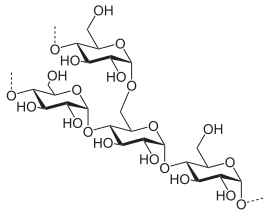 Left: the branching structure of starch. The '...' link to additional starches of glucose molecules (see below image). A single starch molecule will be comrpised of many hundreds of glucose molecules. |
 |
A single molicule of gluocse. Images from wikipedia.
|
The process of breaking down starch into sugars and dextrins is called saccrification (or conversion), and is driven by soaking grain in water at the desired temperature (generally 63-66C). At these temps, enzymes called amylases break down starches into sugars and dextrins. Many beginning brewers simply wait-and-hope for conversion to complete.
If only there were a better way...
Monday, 6 August 2012
Eight Hundred Billion
This is either the happy, or depressing, thought of the day.
I am in the process of trying to setup a yeast bank so that I can share yeasts with brewers around the country. As part of this, I've been researching yeast growth characteristics in wort under various conditions.
As part of this research I came across a staggering number - 50,000,000. That is, on average, the peak number of yeast you'll find in the average batch of homebrew - per millilitre. Fifty million per mil (range is 40-60 million/ml).
Wow.
Taking into account the average sized batch of beer (5US gal, 19L), and the amount of yeast typically left in finished (unfiltered) beer, that works out to 800,000,000,000 yeast dying for one batch of beer. Eight Hundred Billion.
Yes, billion - with a 'B'.
I've got to work that into a label for a future batch of beer - something like 'Eight Hundred Billion yeast died to bring you this beer - you better enjoy it'.
Too dark?
I am in the process of trying to setup a yeast bank so that I can share yeasts with brewers around the country. As part of this, I've been researching yeast growth characteristics in wort under various conditions.
As part of this research I came across a staggering number - 50,000,000. That is, on average, the peak number of yeast you'll find in the average batch of homebrew - per millilitre. Fifty million per mil (range is 40-60 million/ml).
Wow.
Taking into account the average sized batch of beer (5US gal, 19L), and the amount of yeast typically left in finished (unfiltered) beer, that works out to 800,000,000,000 yeast dying for one batch of beer. Eight Hundred Billion.
Yes, billion - with a 'B'.
I've got to work that into a label for a future batch of beer - something like 'Eight Hundred Billion yeast died to bring you this beer - you better enjoy it'.
Too dark?
Subscribe to:
Posts (Atom)