Showing posts with label cat_Zymurgy. Show all posts

Friday, 12 May 2017

To Vrai or Not To Vrai - Another White Labs Controversy?

The Short Version

Brewing practices in both home and commercial breweries have undergone somewhat of a revolution over the past decade, leading to a cohort of brewers who approach brewing from a much more technical & microbiological perspective. As a direct consequence of this, some commercial yeast products have been revealed to be other than what the manufacturers have stated - in at least some cases, with the manufacturer themselves being unaware that their product was a yeast/bacteria different from what they believed they had. In this blog post we reveal that the yeast sold by White Labs as Brettanomyces vrai (WLP648) - ironically a yeast mis-identified previously by the same manufacturer - is, in fact, a blend of two different yeasts - both are Brettanomyces bruxellensis, but are separate strains...although strains which appear to have evolved from a recent common ancestor.

Some Background

Brewing practices have changed dramatically over the past decade, with procedures such as sour worting, wild captures, and home/brewery isolated yeasts going from rare experiments to commonplace brewing practices. This change in brewing practices has led to some issues with commercially sourced yeasts - as one example, the growth of practices such as sour worting have revealed yeast-contamination issues in packaged "pure" strains of Lactobacillus. Similarly, the more microbiology-centric practices of home and commercial brewers has led to some unexpected revelations, including identification of "Brettanomyces trois" as a unusually flavourful strain of conventional brewers yeast (Saccharomyces cerevisiae). I was part of that effort, and the results of my and others work in identifying this yeast are the subject of a previous post. According to the manufacturer, this mis-identification was due to a chance contamination of "Brett trois" by this strain of Sacc, leading to the release of the "correct" strain of Brettanomyces, under the 'vrai' (French for 'true') strain name.

But is the strain name accurate - is this truly a pure strain of Brettanomyces? Most of us assumed so, even though this strain shows some characteristics when used as a pure culture for primary fermentation that run contrary to how most Brettanomyces behave when used for primary fermentation. When used in primary fermentation, most Brettanomyces act much like Saccharomyces - they rapidly ferment the wort, usually leave some residual sugars behind, and don't evolve over ageing as much as beers do when Brettanomyces are added during secondary fermentation - e.g. there is a lack of phenol production and super-attenuation. Beers brewed with WLP648 do ferment out fairly quickly, but tend to be more highly attenuated than beers brewed with other strains of Brettanomyces as the primary yeast. In addition, beers brewed with WLP648 also show some development during ageing similar to that of beers with Brettanomyces added to secondary - i.e. emergence of phenolic "funk", and additional attenuation of the beer. So is WLP648 simply a more aggressive Brettanomyces than other common brewing strains, or is something else going on?

To our knowledge, it was assumed by other brewers that Brett vrai was simply a somewhat more attenuative strain of Brett - that is - until my friend and brewing collaborator (and co-author of this blog post) Devin streaked WLP648 on a wort-agar plate. Initially, the plate appeared as one would expect of a pure culture - all colonies on the plate appearing similar in size, shape and colouration. But over a longer incubation time smaller colonies began to appear between the larger colonies, leading us to speculate that there may be a second strain of yeast in WLP648.

Using a combination of classical microbiology, microscopy, gene sequencing and test batches, Devin and I explored the two strains of yeast present in WLP648, demonstrating that Brett vrai contains two unique strains of Brettanomyces bruxellensis, strains which share a relatively recent common ancestor, but are otherwise quite different in their morphology and brewing characteristics.

Experimental details can be found below the fold.

Tuesday, 18 March 2014

I get email...

While many of my readers reply directly here on my blog, I do get the occasional email asking questions in relationship to some of my posts. While a lot of these are simply requests for clarification, some are seeking details missing from posts, questions expanding on posts, and requests for posts/videos.

I've compiled a bunch of questions from various emailers, and answered them below.

Questions are divided by category:
  • Mailing Yeasts
  • Wild Brewing
  • Yeast Wrangling

Monday, 28 January 2013

Brewing Science: Gelatin & Clearing Beer

I was bottling my Merlins Mild this Friday, and while preping my gelatin, I realized it has been a while since I did an article on brewing science.  The two thoughts merged, leading to this article on how gelatin helps clear beer.

Firstly, a brief outline of how I use gelatin for fining my beer.  There are a lot of other methods out there, but this is what I have found works for me.
  1. Cool the beer as cold as you can (crash cooling), you can do this in a fermenter or keg.  The colder it is, the clearer the final beer will be.  I've had good results at 18-20C, but for crystal-clear beer you need to be at 5C or cooler.  Don't freeze it...
  2. In a lidded pot, add 1 packet (1 tablespoon) unflavoured gelatin to 250-350 ml (1 to 1.5 cup) boiled and cooled water (20C/room temp or colder).  Let sit 20 minutes to 'bloom'.  You'll notice that the gelatin will swell, from small prills to balls 0.5-1 mm in diameter.
  3. Heat gently, in a pot covered with a lid, to 77C (170F).  Remove from heat, keeping covered, and let cool to room temperature.
  4. Add to top of cold beer.
  5. In 2-3 days, beer should be super-clear.  You can bottle at this point.  If in a keg, you can begin carbing as soon as the gelatin is added.
Note that pre-boiling the water is optional, but this does sanitize the water.  It is important to add the gelatin to room temp or colder water for blooming - warmer than that will lead to clumping and incomplete blooming.  It is absolutely essential to heat to 77C; a little cooler and the gelatin will not solubilize, a little warmer and it will gel in your beer.

The science behind how this works can be found below the fold...

Wednesday, 12 December 2012

The Genetics of Beer Foam

Fear the frankenyeast!
Several weeks ago it was announced that a yeast gene responsible for helping create the head on beer had been discovered[link to actual science paper].  As with most scientific discoveries, this was met with a mixture of really bad reporting and screams of terror from those who think a cloud of frankenyeast are about to descend on society, consuming all of us in an orgy of genetically-engineered fermentation.

So what was really discovered?  What does it do?  What does it mean?  All is explained, below the fold.

Sunday, 21 October 2012

Monday, 3 September 2012

Brew Science: The Iodine Test

This is in first of a series of articles about the science behind basic brewing processes.  These articles will explain how many of the procedures we use in brewing work - and hopefully provide sufficient information on how to make us of these tests/processes in your own brewing.

An iodine test [wikipedia] is used by brewers to test for conversion of unfermentable starches into the mixture of fermentable sugars and unfermentable dextrins which comprise the sweet wort we ferment to make beer.

The presence of starch in beer is very much unwanted.  Starches cannot be fermented, and induce an unpleasant appearance and feeling the the resulting wort.  In contrast, fermentable sugars (mostly glucose, or 2-3 glucose's attached togeather - AKA maltose and maltriose) are consumed by yeast to make alcohol, and unfermentable dextrins (short chains of glucose) which impart a malty flavor and mouth-feel to the beer.


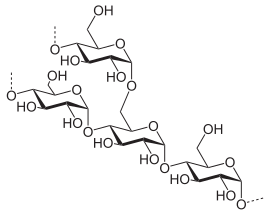
Left: the branching structure of starch.  The '...' link to additional starches of glucose molecules (see below image).  A single starch molecule will be comrpised of many hundreds of glucose molecules.

Above: the structure of the long chains of glucose.  
 A single molicule of gluocse.  Images from wikipedia.

The process of breaking down starch into sugars and dextrins is called saccrification (or conversion), and is driven by soaking grain in water at the desired temperature (generally 63-66C).  At these temps, enzymes called amylases break down starches into sugars and dextrins.  Many beginning brewers simply wait-and-hope for conversion to complete.

If only there were a better way...

Monday, 6 August 2012

Eight Hundred Billion

This is either the happy, or depressing, thought of the day.

I am in the process of trying to setup a yeast bank so that I can share yeasts with brewers around the country.  As part of this, I've been researching yeast growth characteristics in wort under various conditions.

As part of this research I came across a staggering number - 50,000,000.  That is, on average, the peak number of yeast you'll find in the average batch of homebrew  - per millilitre.  Fifty million per mil (range is 40-60 million/ml).

Wow.

Taking into account the average sized batch of beer (5US gal, 19L), and the amount of yeast typically left in finished (unfiltered) beer, that works out to 800,000,000,000 yeast dying for one batch of beer.  Eight Hundred Billion.

Yes, billion - with a 'B'.

I've got to work that into a label for a future batch of beer - something like 'Eight Hundred Billion yeast died to bring you this beer - you better enjoy it'.

Too dark?